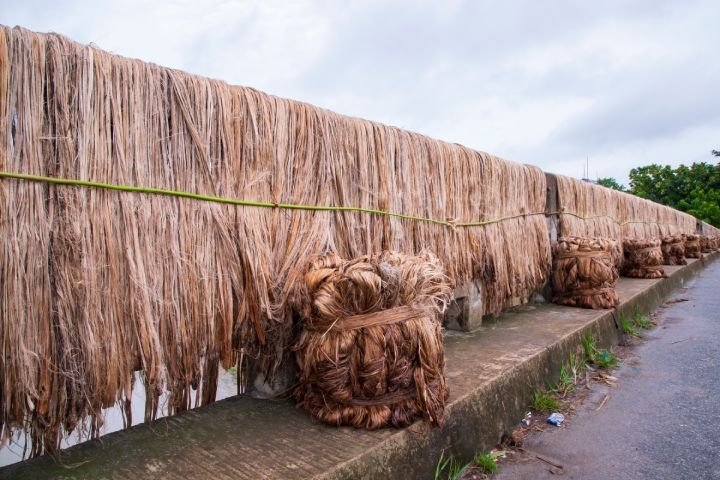
Jute producing states in India are the driving force behind the world’s largest jute economy. India produces 75% of global jute output with an astonishing 83.08 lakh bales in 2024–25, making it the undisputed global leader.
Known as the ‘Golden Fibre’, jute is nature’s gift to sustainable packaging. It is stronger than cotton, fully biodegradable, and incredibly affordable. It has served human civilisation since the Indus Valley era (2200 BC).
From the fertile banks of the Hooghly to the hills of Meghalaya, 10 Indian states power this remarkable industry. Of which West Bengal alone accounts for 75%.
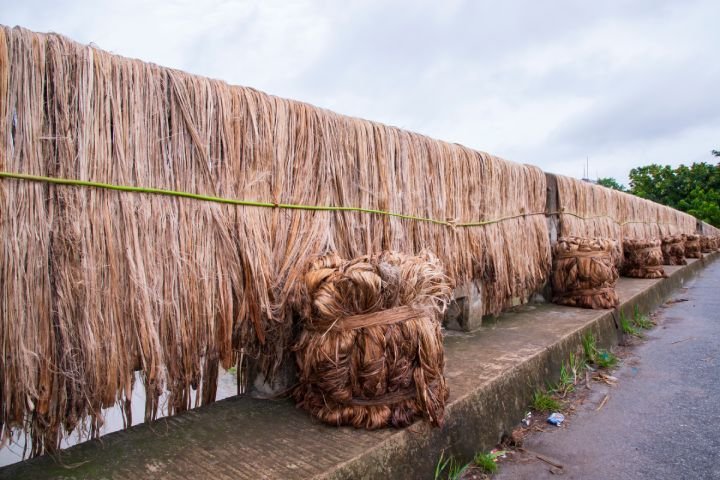
Quick Facts About the Indian Jute Industry
| Crop Type | Kharif Crop |
| Best Grows in | Rich Alluvial soil, generally found in river delta regions |
| Global Rank | No. 1 Producer (75% of World Output) |
| Total Mills in India | 70 |
| Workers Employed across India | ~4 Lakhs |
| Cultivation Area | ~8 Lakh Hectares |
| MSP (2025-2026) | 5,650 per Quintal |
| Domestic Consumption | 90% of production |
Top Jute Producing States in India – Facts and Figures
| Rank | State | Production of Bales Annually in Lakhs | Share of National OutPut |
| 1 | West Bengal | 75.93 | ~75% |
| 2 | Assam | 7.94 | ~8% |
| 3 | Bihar | 7.87 | ~8% |
| 4 | Meghalaya | 0.95 | ~1% |
| 5 | Nagaland | 0.38 | <0.4% |
| 6 | Odisha | 0.29 | <0.3% |
| 7 | Andhra Pradesh | 0.10 | <0.1% |
| 8 | Tripura | 0.06 | <0.6% |
| 19 | Chhattisgarh | 0.01 | <0.01% |
| 10 | Jharkhand | – | Negligible |
1. West Bengal – Top Jute Producing State in India
West Bengal is the largest jute-producing state in India, leading the country in raw jute cultivation since Independence. With fertile alluvial soil, abundant rainfall, and a warm, humid climate, the state provides ideal conditions for jute cultivation.
Bengal contributes approximately 75–80% of India’s total jute production, producing around 80–90 lakh bales of raw jute annually (1 bale = 180 kg).
Jute cultivation in the state covers nearly 5.15 lakh hectares, highlighting its agricultural significance.
Major jute-producing districts in West Bengal include Murshidabad, Nadia, North 24 Parganas, Hooghly, Cooch Behar, Jalpaiguri, and Malda. With a strong agricultural base and a well-established jute industry, West Bengal remains the backbone of India’s jute sector.
2. Bihar
Bihar is India’s second-largest producer of raw jute, contributing around 9–10% of the country’s total jute output.
The state produces an average of 8.03 lakh bales of raw jute annually, making it a major contributor to India’s jute sector.
As of 2025, jute is cultivated across approximately 0.59 lakh hectares in Bihar, with an average productivity of 2,442 kg per hectare, slightly below the national average of 2,654 kg per hectare.
Jute cultivation in Bihar is mainly concentrated in the Seemanchal region, particularly in districts such as Purnea, Kishanganj, Araria, Katihar, Madhepura, and Supaul.
While Purnea is widely recognised as the leading jute-producing district, Supaul has recorded the highest bale production in certain years.
Despite strong cultivation, Bihar has limited jute processing infrastructure, with only a small portion of raw jute processed within the state. Many farmers are also gradually shifting to crops such as paddy and maize, which often yield higher financial returns.
3. Assam – Top Northeast Jute Producing State
Assam is India’s third largest jute producing state, contributing approximately 6–8% of the country’s total raw jute production, with an annual output of around 5–7 lakh bales.
Jute grows well in Assam due to its fertile alluvial soil, heavy monsoon rainfall, warm, humid climate, and extensive Brahmaputra river floodplains, which provide ideal cultivation conditions.
Major jute-producing districts include Nagaon, Barpeta, Dhubri, Goalpara, and Kokrajhar.
As a key part of India’s eastern jute belt, Assam continues to play an important role in sustainable natural fibre production.
While Assam is a top jute-producing state, it still faces limitations, including insufficient jute-processing infrastructure, competition from more profitable crops, and frequent flooding.
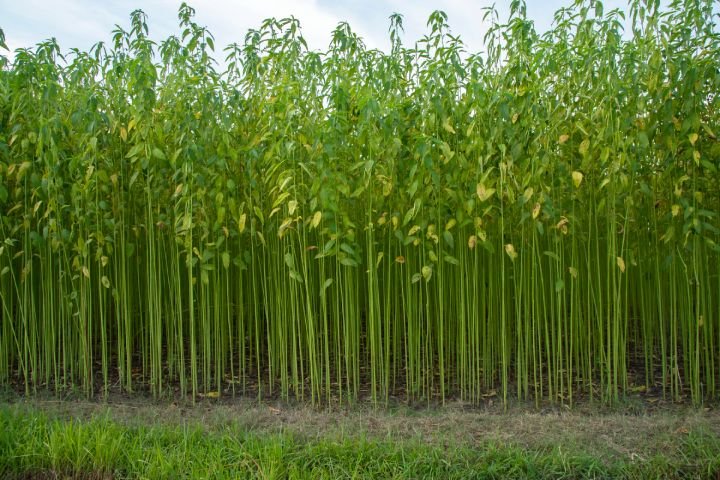
4. Meghalaya
Nestled in the hills of Northeast India, Meghalaya has quietly emerged as the 4th largest jute producing state in India.
The state produces between 95,000 and 97,000 bales of raw jute annually, accounting for approximately 1–2% of India’s total output.
Its warm, humid climate and high rainfall make it ideal for growing both White Jute (Corchorus capsularis) and Tossa Jute (Corchorus olitorius).
Most cultivation is concentrated in the Garo Hills and Ri-Bhoi districts. Unlike major producers, Meghalaya has no large-scale jute mills.
The state instead focuses on local weaving, rope-making, and eco-friendly handicrafts, a fast-growing niche in today’s sustainable packaging market.
Hilly terrain remains the biggest barrier to industrial growth. However, government schemes such as NJDP and ICARE are helping farmers improve yields and fibre quality, positioning Meghalaya as a rising sustainable jute hub in Northeast India.
5. Nagaland – The Emerging Jute Producing State of North East
Among the emerging jute-producing states in Northeast India, Nagaland is gradually building its presence in India’s raw jute sector.
While its share in national production remains small, the state has shown steady progress in jute cultivation over recent years.
Nagaland produces approximately 42,900 bales of raw jute annually, with cultivation spread across nearly 4,400–4,600 hectares. Jute farming is mainly concentrated in Dimapur and Peren districts, where favourable climatic conditions support crop growth.
Unlike major jute-producing states such as West Bengal, Bihar, and Assam, Nagaland’s jute sector is largely driven by small-scale farmers, local weaving communities, and MSME-based natural fiber activities, rather than large industrial processing units.
The Government of India supports jute cultivation in the state through programs like the National Jute Development Programme, helping improve productivity and farmer participation. Though still a smaller producer, Nagaland has growing potential in India’s sustainable jute economy.
6. Odisha
Among India’s notable jute producing states, Odisha holds an important place as a regional producer of raw jute. The state produces approximately 58,000–60,000 bales of raw jute annually, with cultivation spread across nearly 6,400 hectares.
Jute cultivation in Odisha is mainly concentrated in the fertile districts of Cuttack, Balasore, and Kendrapara, where favourable soil conditions and adequate rainfall support crop growth. The crop has traditionally been cultivated by small and marginal farmers, often alongside paddy farming.
Unlike major jute-producing states, Odisha has limited large-scale jute processing infrastructure. Most locally produced jute is used for small-scale handicrafts, ropes, bags, baskets, and eco-friendly products, rather than industrial manufacturing.
Despite suitable climatic conditions, jute cultivation in Odisha remains limited due to lower farmer incentives, competition from more profitable crops, and the lack of major jute mills and industrial processing facilities.
However, the state continues to hold potential for growth in sustainable jute-based industries.
7. Andhra Pradesh – State with Sharpest Decline in Jute Production
Andhra Pradesh, the only South Indian state among India’s top 10 jute producers, has seen one of the sharpest declines in jute farming in the country.
In 1974, jute cultivation covered nearly 1.8 lakh hectares. Production peaked at 750,000 tonnes in 1982. By 2023, cultivated area had fallen to just 694 hectares a drop of over 99% in five decades.
Today, the state produces around 10,440 bales per year.
Jute farming has also shifted location. It once thrived in Krishna, Guntur, and East Godavari. Now it has moved north to Srikakulam, Vizianagaram, and Parvathipuram Manyam. Srikakulam is the most active district today, with processing units in Rajam and Kotturu Mandal.
One of the major reasons for the decline of jute cultivation is that farmers now prefer paddy and aquaculture, which are both far more profitable and have high demand across the nation.
8. Tripura
A small state with a steady contribution, Tripura ranks 8th among India’s top jute producing states.
The state produces around 6,230 bales of raw jute each year. That number may look small. But Tripura stands out for one important reason: It has a composite jute mill, owned and operated by the Government of Tripura itself. This gives the state a rare end-to-end jute processing capacity.
Jute grows mainly in the West Tripura and Sepahijala districts. The warm, humid climate and moderate rainfall here are well suited for jute cultivation.
Tripura also has a key geographic advantage. It shares a long border with Bangladesh, the world’s second-largest jute producer. This opens the door to cross-border trade in the jute sector.
Like many other states, Tripura faces challenges such as limited industrial growth and slow adoption of technology in jute processing. Government schemes like NJDP and ICARE are helping, but progress is gradual.
9. Chhattisgarh
Ranked 9th among India’s jute producing states, Chhattisgarh is still building its jute industry, but the foundations are firmly in place.
The state produces around 1,310 bales of raw jute annually, across approximately 250 hectares of cultivated land. Numbers are modest, but growth is steady.
Jute grows mainly in the northern and eastern districts of the state, where higher rainfall and well-drained soils create suitable conditions for the crop.
On the processing side, Chhattisgarh is better equipped than its output suggests.
The state has 2 composite jute mills. The Mohan Jute Mill in Raigarh is one of the oldest jute mills in India. A second mill operates in the Bilaspur region. Together, they process locally grown jute fibre into finished goods.
The state also has small jute craft units that make bags, accessories, and handicrafts. Demand for these eco-friendly products is growing across India.
The Government of India is encouraging Chhattisgarh to expand jute farming beyond its eastern districts to other suitable regions of the state.
10. Jharkhand
Ranked 10th among India’s jute producing states, Jharkhand is not yet a commercial jute producer but its potential is real.
The state shares a border with West Bengal, India’s jute capital. This gives Jharkhand a natural advantage. The climate and soil conditions are similar. Districts such as Santhal Parganas and Kolhan receive sufficient rainfall to support jute cultivation.
But three challenges have held the state back, including poor retting infrastructure, lack of price support and farmers preferring other crops.
With government backing and the ICARE scheme (Improved Cultivation and Advanced Retting Exercise), Jharkhand is making slow but steady progress.